Capability, Confidence & Coordinated Action
An executive discussion paper examining the conditions that allow capability to emerge, confidence to form and coordinated action to occur.
Executive Briefing
Capability is a familiar word inside organisations, but it is often used too easily.
A board may speak about capability as though it sits inside the workforce. An executive team may treat capability as a funding problem. An investor may look for capability in evidence, discipline and confidence. Government may see capability through resilience, participation and public value. Each view is legitimate. None is complete.
The risk is that an organisation can spend years improving individual parts of the system while the capability it is seeking remains difficult to produce. More people may be recruited. More capital may be committed. More governance may be introduced. More reports may be written. Activity increases, but confidence does not necessarily follow.
That is the starting point of this report.
Capability should not be treated as something an organisation simply possesses. In complex environments, capability behaves more like an outcome. It emerges when people, evidence, authority, judgement, participation and action relate in ways that can be trusted over time.
This report is designed to be taken inside an organisation. It is not asking for agreement. It is asking for interrogation. The useful question is not whether every statement applies equally to every organisation. The useful question is whether the pattern described here is already present, under-recognised or unresolved.
If the report creates one useful response, it should be this:
We should examine whether this describes us.
That is where meaningful observation begins.
Strategic Context
The operating context for capability has become less forgiving. Workforce requirements are changing, trust in institutions is under pressure, decision-making is increasingly exposed to complex evidence environments, and governments are being asked to coordinate across policy domains that do not behave independently.[^1][^2][^3]
None of those pressures proves the YOYAKKA argument on its own. They simply explain why the argument matters. Organisations are operating in conditions where capability can no longer be understood through isolated functions. A workforce issue may affect investment confidence. Weak confidence may slow infrastructure. Delayed infrastructure may add operational pressure. Operational pressure may reduce participation. Reduced participation may weaken future capability.
The visible issue is rarely the whole issue.
The report therefore adopts a systems view, but not a technical one. It does not claim complexity can be removed. It argues that complexity must be made more legible so leaders can see whether evidence, authority and judgement are becoming coordinated enough to support action.
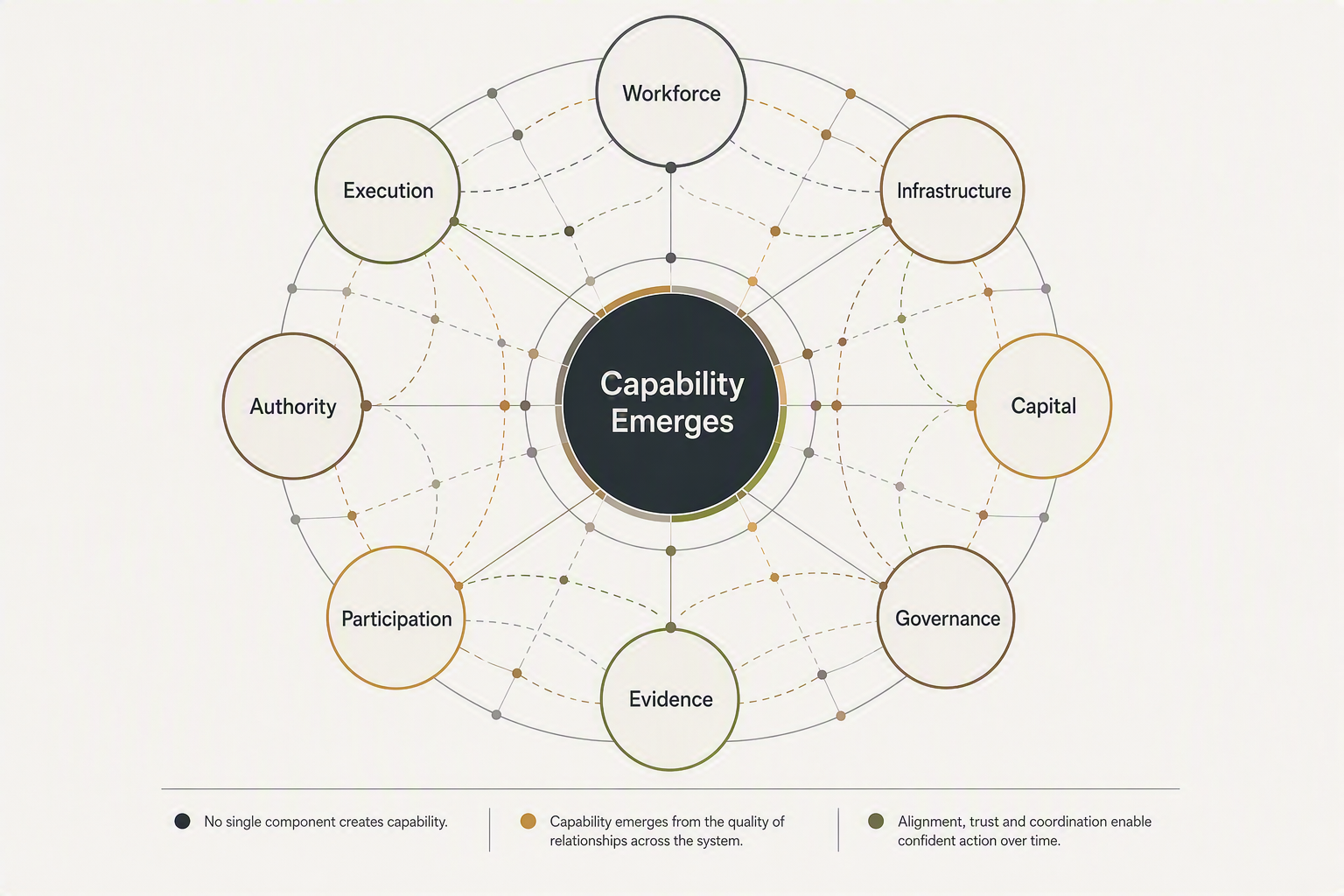
Figure 1 — Capability Is Not A Single Component. Capability is not produced by one element alone. It emerges when people, systems, evidence, authority, capital and participation relate in ways that can support confident action over time.
The Problem Beneath The Problem
Most organisations are good at seeing visible problems.
A project runs late. A workforce gap appears. A facility cannot scale. An investment case loses momentum. A policy initiative produces less effect than expected. A promising opportunity remains trapped inside discussion, review or partial execution.
These problems are rarely ignored. They attract meetings, papers, advice, funding requests, reviews and corrective action. Serious people devote serious effort to them. Yet the same pattern often returns under a different name.
A workforce issue becomes a skills initiative. The skills initiative becomes a training pathway. The training pathway becomes a participation challenge. The participation challenge becomes a governance problem, a funding problem or a confidence problem. The conversation moves. The condition remains.
That is the problem beneath the problem.
The deeper difficulty is that visible issues are often treated as independent. A workforce shortage is treated as a workforce issue. An investment hesitation is treated as a capital issue. A production delay is treated as an operational issue. A regulatory burden is treated as a compliance issue.
Each interpretation may be reasonable. Each may contain useful evidence. Each may justify action. Each may also be incomplete.
In complex environments, visible problems are often symptoms of a deeper coordination condition. They reveal that the relationships between people, systems, capital, governance, infrastructure, evidence and action are not strong enough to support the outcomes being pursued.
An organisation may have skilled people, but not participation. It may have capital, but not confidence. It may have governance, but not clarity. It may have information, but not shared judgement. It may have strategy, but not coordinated action.
Capability does not appear simply because the ingredients exist.
This is where trusted coordination matters. Trusted coordination is not another meeting structure or a new reporting process. It is the ability to align evidence, authority and judgement so people can act with confidence without surrendering their responsibilities, autonomy or perspective.
Where trusted coordination is weak, organisations often compensate with control. More reporting. More approvals. More escalation. More assurance. These responses may be understandable. They may also slow participation and reduce confidence if they add friction without improving shared understanding.
The problem beneath the problem is therefore not absence of effort, intelligence or ambition. It is the difficulty of turning distributed capability, evidence and judgement into confident, coordinated action over time.
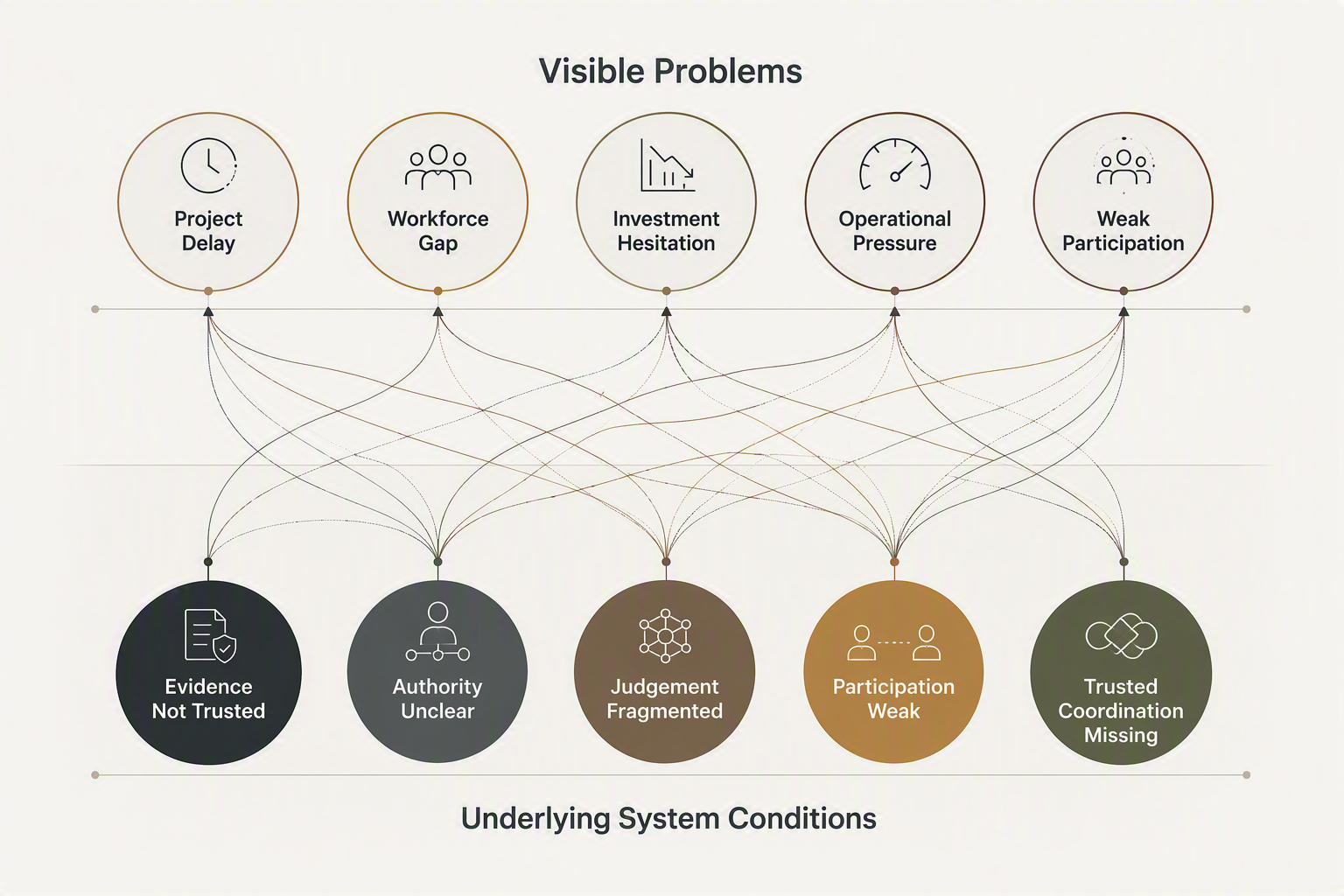
Figure 2 — The Visible Problem And The System Condition. Visible issues often appear separate. Beneath them may sit a shared system condition affecting evidence, authority, confidence, participation and coordinated action.
Why Capability Conversations Repeatedly Stall
Capability conversations stall when people believe they are discussing the same issue while actually discussing different interpretations of it.
An executive may hear capability and think of strategic readiness. An operator may think of execution under constraint. An investor may think of confidence and return. Government may think of resilience and public value. A workforce participant may think of skills, incentives and practical conditions.
Each view may be legitimate. The difficulty is that each view describes the part of capability most visible from where that participant stands.
The conversation appears aligned because everyone uses the same word. It stalls because everyone is not using the same meaning.
This becomes difficult when every interpretation is supported by evidence. The workforce case may be real. The capital case may be real. The operational case may be real. The governance case may be real. The institutional case may be real.
The issue is not that one group is right and another is wrong. The issue is that the organisation has no trusted way to combine partial truths into a shared basis for action.
The organisation may then try to choose which interpretation should dominate. Should the matter be treated as workforce, capital, governance, delivery or strategy? That choice can become a false choice. A workforce shortage may also be a confidence issue. A capital constraint may also be an evidence issue. Slow execution may also be an authority issue. Weak engagement may also be a participation issue.
When those relationships are not visible, the same conversation repeats. More analysis is requested. More consultation occurs. More evidence is gathered. Another paper is written.
The organisation may be learning more, but it is not necessarily forming judgement.
Learning accumulates information. Judgement determines what deserves action. Capability conversations stall when information accumulates faster than shared judgement can form.
The question is not whether the organisation has intelligence. Most organisations do. The question is whether the organisation has a way to coordinate that intelligence so it can support action.
The Cost Of Fragmented Thinking
Fragmented thinking rarely looks irresponsible at first.
It often looks like good management. Different teams manage different responsibilities. Different committees examine different risks. Different reports measure different activities. Different leaders focus on the matters closest to their authority.
Organisations need structure. Responsibility must be distributed. Expertise must sit somewhere.
The problem begins when the structure used to manage responsibility becomes the structure used to understand reality.
Complex systems do not respect organisational boundaries. A workforce issue does not remain only a workforce issue if workforce readiness influences production reliability, investor confidence, regulatory trust, service continuity or national resilience. A capital issue does not remain only a capital issue if investment hesitation has been caused by weak evidence, unclear governance, poor participation or unresolved operational dependencies.
Fragmented thinking treats these matters separately even when the system is producing them together.
The cost is not always immediate. It may first appear as activity. Strategies are commissioned. Frameworks are developed. Reports are prepared. Funding proposals are assessed. Risks are documented. Milestones are tracked.
From a distance, the organisation looks active.
Closer inspection may show that the activity is real but the understanding remains incomplete.
A workforce programme may advance without resolving why people do not participate. A capital strategy may be written without resolving why confidence is weak. An operational improvement plan may be approved without resolving the governance conditions that prevent action.
Each initiative may be defensible in its own terms. The underlying condition may still remain unchanged.
This is one of the more expensive forms of organisational failure because it does not look like neglect. It looks like effort.
Over time, fragmented thinking creates decision fatigue. Executives are asked to judge partial interpretations. One paper presents the workforce case. Another presents capital. Another presents operational risk. Another presents strategic opportunity. Each contains evidence. Each asks for attention.
The difficulty is not lack of information. The difficulty is that the information is not forming a coherent operating picture.
When evidence remains fragmented, judgement becomes harder. Leaders may still make decisions, but confidence becomes thinner. Participants comply with decisions without necessarily believing the system understands the conditions it is acting within.
That matters because confidence influences whether people commit attention, capital, authority, effort and trust.
Fragmented thinking also produces false alignment. Everyone agrees that capability matters. That does not mean everyone means the same thing by capability. The word creates agreement while the meanings beneath it diverge. This is how capability conversations can appear to move forward while quietly moving in circles.
The final cost is strategic underperformance. Nothing collapses. Projects continue. Reports are produced. Governance operates. But capability does not compound.
The organisation becomes capable of maintaining activity, but not necessarily of strengthening the conditions that allow capability to emerge.
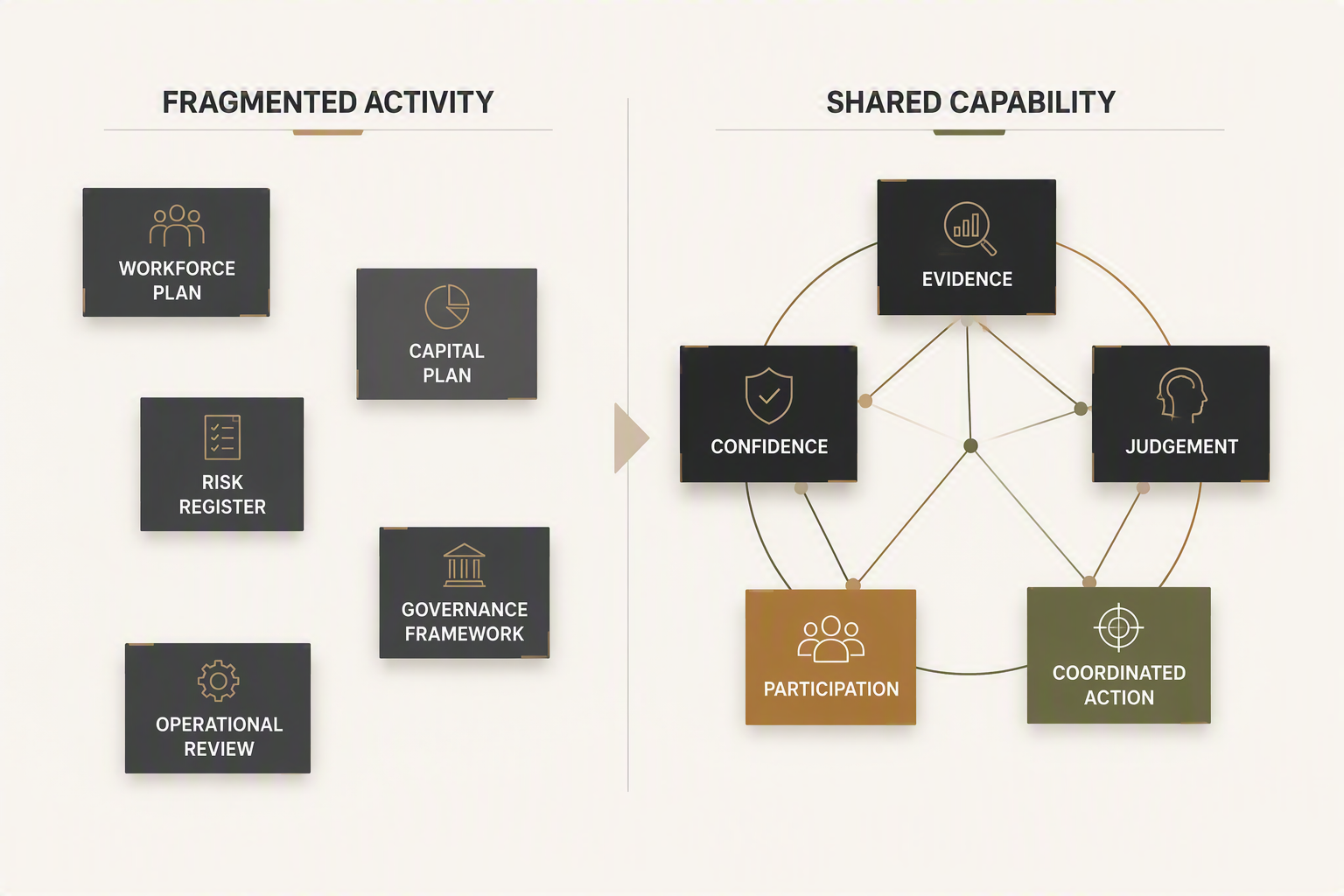
Figure 3 — Fragmented Activity Versus Shared Capability. Fragmented activity can produce documents, decisions and initiatives without producing shared capability. Capability strengthens when evidence, judgement, confidence, participation and action begin to connect.
The Missing Relationship
Most capability conversations begin with known elements.
The workforce is known. The infrastructure is known. The capital requirement is known. The governance framework is known. The market opportunity is known. The risks are known, or at least assumed to be knowable through further analysis.
Organisations must name things before they can manage things. That discipline is necessary. It is not sufficient.
In complex environments, the missing element is often the relationship between the known elements.
A workforce requirement is not only a number. It is shaped by confidence, governance, participation, identity, incentives and operational certainty. A capital requirement is not only a funding line. It is shaped by evidence, timing, trust, execution readiness and belief that the system can absorb commitment. A governance requirement is not only a control. It can either enable judgement or delay it.
The elements are visible. The relationships are harder to see.
Capability is often produced in the relationship, not in the component. A skilled workforce becomes capability only when the conditions exist for that workforce to contribute effectively. Capital becomes capability only when it enters an environment capable of converting investment into sustained execution. Governance becomes capability only when it enables judgement, trust and action rather than merely recording control.
A component can be strong and still fail to produce capability if the relationship surrounding it is weak.
The missing relationship is often the relationship between evidence and authority, authority and judgement, judgement and participation, participation and action, and action and learning. When those relationships are weak, the organisation compensates. It asks for more evidence, but the evidence does not change decisions. It creates more governance, but governance does not create trust. It seeks more confidence, but confidence cannot form because the operating conditions remain unclear.
Trusted coordination is the condition in which evidence, authority and human judgement can move toward action without forcing participants to surrender their perspective, autonomy or responsibility. It allows different forms of intelligence to remain distinct while still becoming useful to one another.
That relationship is often missing not because people reject it, but because most organisational systems are not designed to see it.
They can see the report, the meeting, the project, the funding decision, the risk register and the approval pathway. They cannot always see whether those things are forming a trustworthy relationship capable of producing capability over time.
Participation As A Capability Engine
Capability cannot be delivered from the top down by resources alone.
Budgets matter. Programmes matter. Infrastructure matters. Expertise matters. Governance matters. Each can contribute to capability. None automatically creates it.
Capability develops when people choose to participate in a system strongly enough, consistently enough and long enough for experience, learning, trust, confidence and action to compound.
Participation is not an asset in the ordinary sense. It is a living condition. It reflects whether individuals, teams, organisations, institutions and communities are willing to contribute effort, attention, judgement and experience to a shared outcome.
Participation cannot simply be purchased and deployed. It must be earned, reinforced and sustained.
This becomes important when capability is expected to develop over years rather than months. An organisation may have infrastructure but weak participation. It may have capital but weak confidence. It may have programmes but limited commitment from the people expected to make those programmes work.
The visible resources may be present. The capability engine may still be weak.
Participation converts resources into capability. A workforce becomes capability when experience, judgement and learning accumulate through meaningful work. An industry becomes capability when organisations develop practical cooperation, shared expectations and trust over time. An institution becomes capability when knowledge and stewardship survive changes in leadership, funding and policy cycles.
Participation allows capability to compound. Without it, systems may continue operating, but they gradually lose their ability to learn.
The decline is rarely visible at first. Meetings continue. Reports continue. Governance continues. Programmes continue. Internally, however, people begin contributing less of themselves. Ideas become more cautious. Initiative becomes more selective. Knowledge sharing becomes more transactional. Effort narrows to formal obligation.
The organisation may continue functioning after participation has begun to weaken. Eventually, capability weakens because the conditions required to renew it are no longer present.
That is why participation is not secondary. It is one of the ways capability reproduces itself.
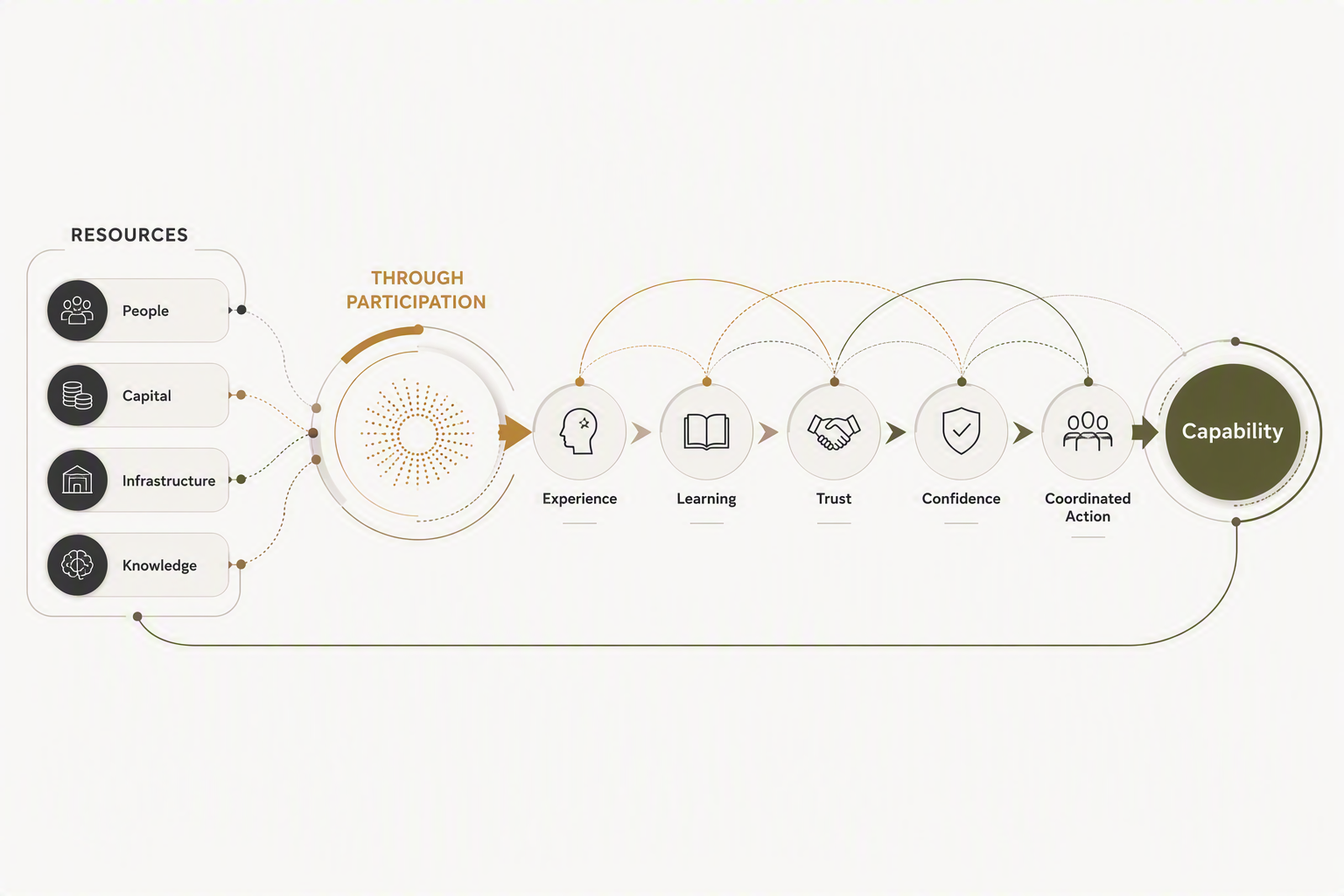
Figure 4 — Participation Converts Resources Into Capability. Participation is the mechanism through which resources begin to generate learning, trust, confidence and coordinated action. Without participation, resources may remain static.
Why Confidence Becomes Difficult To Establish
Confidence is often discussed as though it were a feeling. It is more useful to treat it as a system condition.
Belief allows people to imagine a possible future. Confidence allows people to act in the presence of uncertainty. An executive may believe a strategy is sound while remaining hesitant to commit resources. An investor may believe an opportunity exists while remaining unwilling to deploy capital. A participant may believe an organisation's intention is positive while remaining reluctant to commit attention, reputation or time.
Belief exists. Confidence has not yet formed.
Confidence sits in the gap between possibility and commitment. It allows people to move from observing to participating. When confidence is present, uncertainty remains but becomes navigable. When confidence is absent, even small uncertainties can prevent action.
This is why confidence becomes difficult in complex environments. No single participant can hold the full operating picture. Workforce conditions influence operational decisions. Operational decisions influence investment confidence. Investment confidence influences infrastructure development. Infrastructure development influences participation. Participation influences capability. Capability influences future confidence.
As interdependence grows, participants rely on assumptions about parts of the system they cannot directly observe. Confidence therefore depends not only on facts, but on trust in relationships, evidence, institutions and judgement.
Many organisations respond to uncertainty by producing more information. More dashboards. More reviews. More analysis. More reporting. These may be useful, but information and confidence are not the same thing.
An organisation can become more informed without becoming more confident.
Confidence depends less on the volume of information than on the quality of the relationship between evidence and judgement. Evidence exists, but people interpret it differently. Executives see opportunity. Operators see implementation risk. Investors see uncertainty. Regulators see obligations. Workforce participants see practical constraints.
Every perspective may be valid. Confidence remains difficult because no common basis for judgement has formed.
Confidence cannot simply be requested. It must be justified. Participants need to see a coherent relationship between evidence, authority, judgement and action. Where that relationship is visible, uncertainty can be navigated. Where it is not, participation becomes conditional and capability becomes harder to sustain.
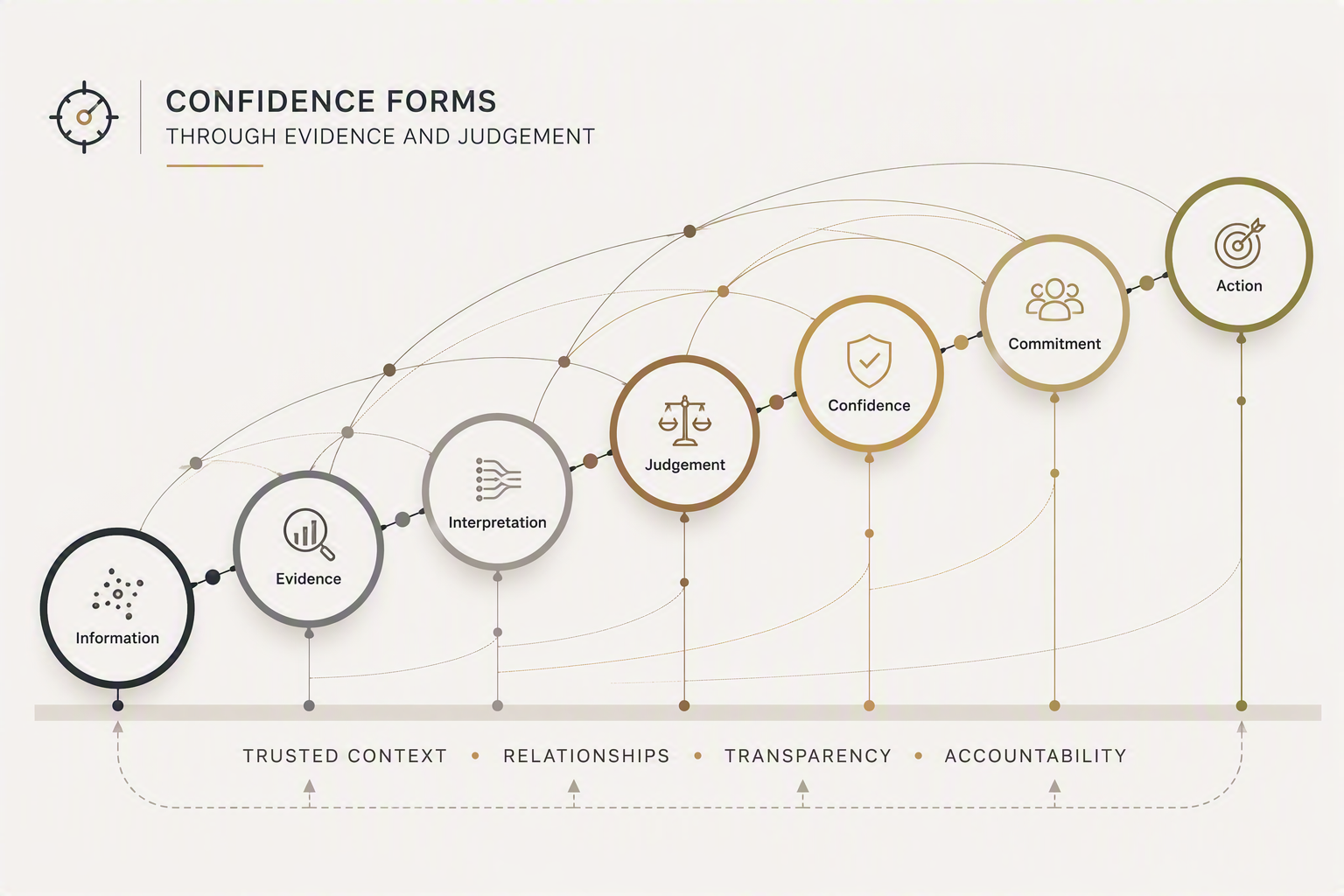
Figure 5 — Confidence Forms Through Evidence And Judgement. Confidence is not created by information alone. It forms when evidence can be interpreted, judged and connected to action in ways participants trust.
The Consequences For Leaders
For leaders, the most difficult consequence of capability failure is not always visible failure. It is loss of clarity.
Executives are surrounded by information. They receive performance reports, strategic reviews, workforce metrics, investment updates, risk assessments, programme status reports, dashboards and market intelligence. They are rarely information-poor. They may still sense that something important remains just beyond view.
The organisation appears active, but progress feels slower than expected. Effort is being applied, yet outcomes remain difficult to sustain. Investment is occurring, yet confidence is fragile. Governance is strengthened, yet decision making becomes harder rather than easier.
The leader begins to suspect that the organisation may not lack activity. It may lack a coherent understanding of how activity is meant to become capability.
When leaders cannot see how capability is being produced, they manage through proxies. Budgets stand in for capability. Milestones stand in for confidence. Outputs stand in for participation. Risk controls stand in for trust.
Proxies are necessary. They become dangerous when they replace the condition they are meant to represent.
A project may meet milestones while losing participation. A programme may remain inside budget while capability fails to deepen. Governance may become more comprehensive while trust weakens. The indicators say one thing. The system condition says another.
As complexity grows, leadership becomes less about directing activity and more about creating the conditions under which evidence, judgement and participation can align.
This changes the nature of executive responsibility. The organisation no longer depends on the leader knowing everything. It depends on the leader helping the system connect what it already knows.
The question is no longer only what decision should be made. It becomes what conditions are preventing good decisions from forming. The question is no longer how to push harder. It becomes why capability is not compounding despite the effort already being applied. The question is no longer who owns the problem. It becomes what relationships are continuously recreating it.
This is a stewardship question. Are leaders merely sustaining the current system, or are they strengthening the conditions that allow capability to emerge, compound and endure over time?
Questions Worth Taking Back To The Organisation
Most reports conclude with recommendations. This report concludes with questions.
That is deliberate. Recommendations assume the problem is already understood. The discussion here suggests that the first task may be to test whether the organisation understands the condition it is trying to change.
The first question is what problem the organisation is actually trying to solve. Most organisations can describe the issue attracting leadership attention. The harder question is whether the visible problem is the real problem, and what conditions keep reproducing it.
The second question is what the organisation means when it says capability. Different leaders may define capability through workforce, infrastructure, capital, technology, governance or institutional performance. Each answer may be valid. The concern is whether people are speaking about the same thing.
The third question is where confidence comes from. Investors seek confidence before committing capital. Executives seek confidence before making decisions. Teams seek confidence before committing effort. Partners seek confidence before deepening relationships. Confidence cannot be managed if it is not understood.
The fourth question is where participation is strengthening capability. Attendance and engagement measures may show involvement. They do not necessarily show whether participation is producing capability. The more useful question is where participation is generating knowledge, strengthening trust, improving judgement and enabling action that would not otherwise occur.
The fifth question is what evidence never reaches action. Most organisations generate more evidence than they can use. Reports are commissioned, risks are documented, lessons are learned and recommendations are prepared. Much of that evidence never becomes action because the relationship between evidence and authority is weak.
The final question is what capability the current system is producing. If capability is something continually produced through people, evidence, authority, participation, investment and action, then capability is either strengthening or weakening, compounding or eroding, becoming more resilient or more fragile.
The answer reveals not only where the organisation is today. It reveals the future toward which its present conditions are quietly directing it.
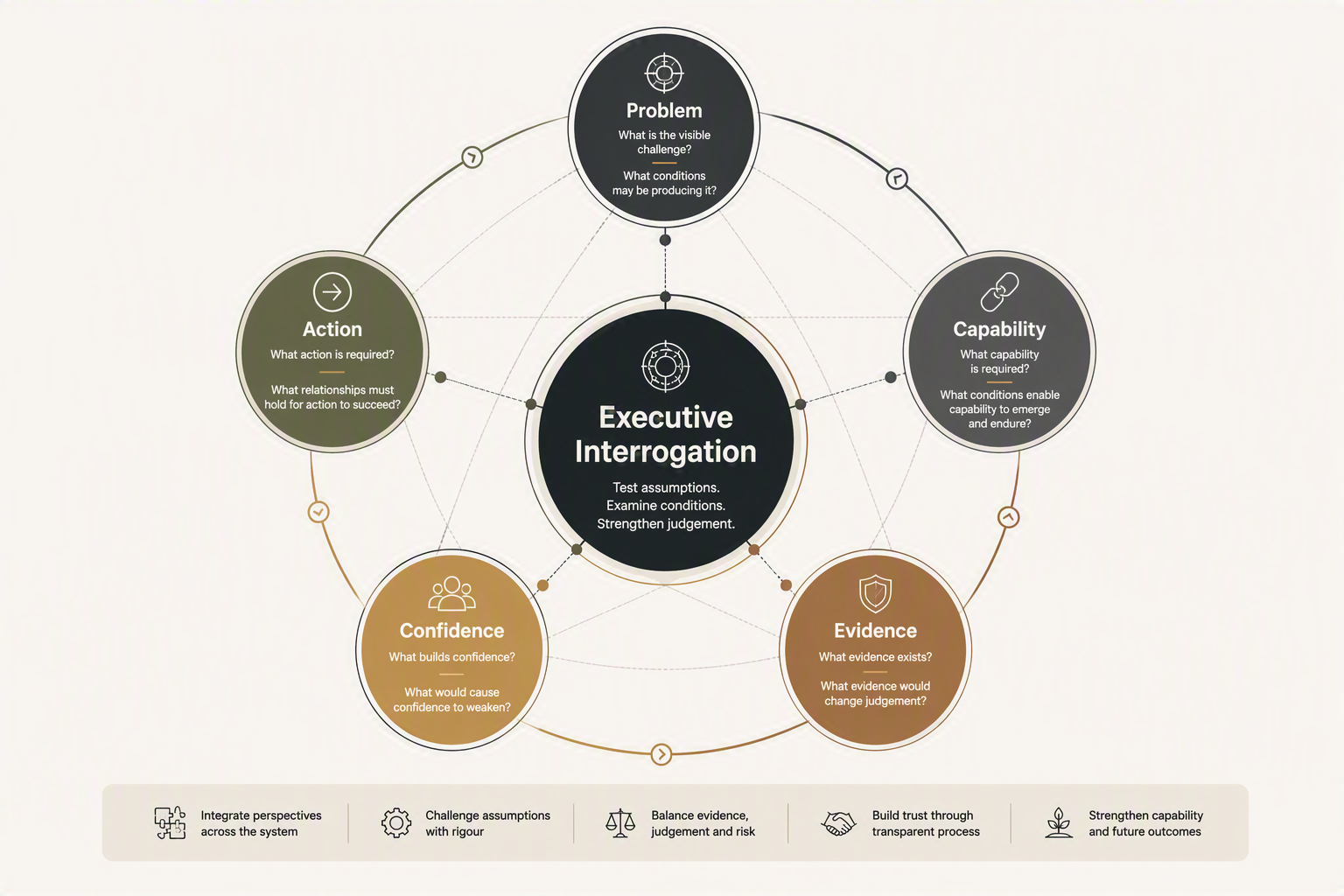
Figure 6 — Executive Interrogation Framework. The report is intended to be taken inside the organisation and used to begin a different capability conversation.
Conclusion
Organisations often ask whether they possess capability. A more useful question may be whether the conditions required for capability to emerge still exist.
That distinction appears small. It may determine whether capability expands, stagnates or quietly disappears over time.
The purpose of this report is not to provide a final answer. Its purpose is to help an executive team begin a more useful discussion about the conditions shaping capability inside its own environment.
Take the report inside the organisation. Read it with others. Ask where it feels familiar. Ask where it feels uncomfortable. Pay attention to where different people disagree.
Those points of divergence often reveal the most important conditions of all.
That is where observation begins. That is where evidence begins. That is where trust can begin to form. Only after that point does deeper participation become meaningful.
Footnotes
[^1]: World Economic Forum, The Future of Jobs Report 2025. Used here as external context for workforce and skills disruption, labour-market transformation and changing operating conditions.
[^2]: OECD, Survey on Drivers of Trust in Public Institutions – 2024 Results. Used here as external context for trust, public institutions and complex policy decision-making.
[^3]: OECD, Policy Coherence for Sustainable Development. Used here as external context for coherent and integrated policy design, implementation and monitoring.
[^4]: ISO, Quality Management Principles. Used here as external context for evidence-based decision making, engagement of people and relationship management.
[^5]: OECD, Skills Outlook 2023. Used here as external context for skills, transitions and resilience.
Access
Access to detailed analysis is provided on request.